

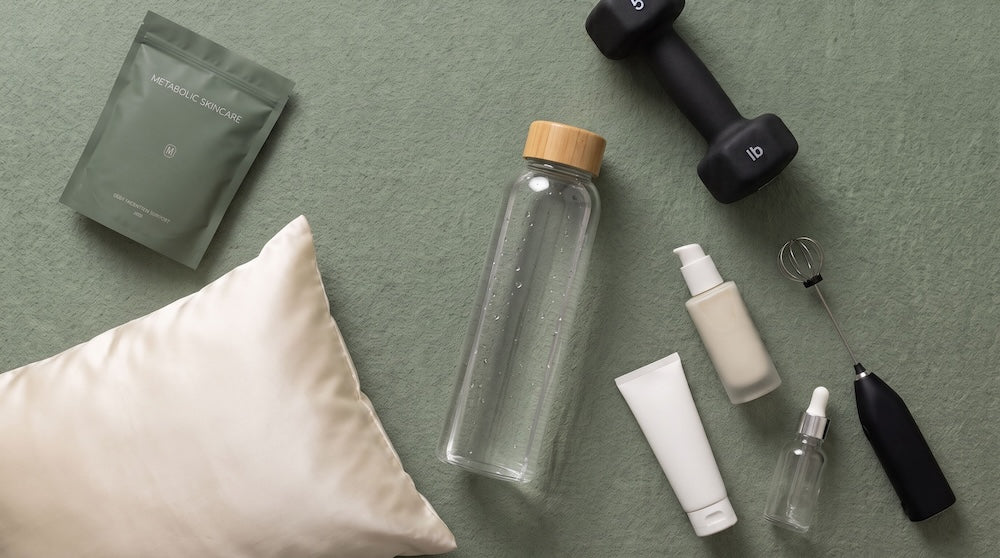
Summary: Most skincare advice sends you to the wrong shelf. What actually decides how your skin looks is a short list: a few habits, plus a couple of products most people use wrong. Almost no one does the full set, which is exactly why doing it is an unfair advantage, the kind others will write off as good genes. Some of it is free, some takes discipline, and all of it compounds, so the sooner you start, the further ahead you pull. Here are all seven:
Lift heavy. Cardio isn't the skin move.
Resistance training is getting more mainstream, but its benefits go beyond your physique. It does something a treadmill can't: it thickens the dermis, the living layer underneath your skin that thins and slackens if you let it. A 2023 study in Scientific Reports put participants through both aerobic and resistance training. Both improved skin elasticity. Only the lifting measurably thickened the skin itself 1. So the person hitting legs twice a week isn't just building their body. They're rebuilding the canvas it's printed on. The person doing steady-state on the elliptical is getting a fraction of the return.
Actually sleep. Your skin repairs on the night shift.
Overnight is when your skin does its real work. While you're sleeping it runs the repair crew: clearing the day's damage, rebuilding its barrier, recovering the moisture it lost all day. Cut the night short and you cut recovery short as well. In a study out of University Hospitals in Clinical and Experimental Dermatology, poor sleepers showed more visible signs of aging and, tellingly, their skin recovered far slower after being stressed than good sleepers' did 2. Same stress, slower repair, compounding night after night. The person who looks rested usually isn't lucky or isn't hiding it under makeup. They're genuinely sleeping seven or eight hours and letting their skin do the work. If you're up scrolling until 1 a.m. you're robbing your face of the hours it needs most.
Sleep on your back.
How much sleep you get isn't the only thing that matters. The way you're positioned in bed can impact your appearance. If you press your face into a pillow for six or seven hours a night, several thousand nights in a row, you're forming additional creases and folds that turn into wrinkles. A 2016 paper in Aesthetic Surgery Journal laid it out 3. These aren't expression lines from smiling or frowning. They're mechanical, carved by years of your own face folded against the sheets, usually on whichever side you favor. No serum reaches them, because the cause isn't on the surface. It's the position. Train yourself onto your back and your face spends the night uncrushed.
Feed your skin from the inside with Deep Structural Support.
This is the easiest change on the list. Skincare doesn't mean just applying products to the surface. Taking care of your skin means supporting the deepest layers with an inside-out approach.
Your skin builds its structural layer from raw materials, and most diets fall short on them. Deep Structural Support is the resupply: hydrolyzed collagen peptides, vitamin C (the cofactor your body uses to build collagen 4), hyaluronic acid, and keratin, in one daily scoop. Not a cream. A skincare supplement that works from beneath the surface.
Then there's the evidence. In a 12-week trial published in Dermatology Research and Practice, participants taking hydrolyzed collagen with vitamin C saw a 19.6% reduction in wrinkle depth and a 22.7% increase in skin elasticity versus placebo 5. One scoop a day. $49, or $39 on subscription, less than most people spend chasing serums that never get past the surface.

Feed your skin from the inside.
Subscription price locked for the life of your subscription. Cancel anytime.
Try Metabolic Skincare12-week money-back guarantee
Wow, I'm on my third order and seeing incredible results. … love this product!
A retinoid, every night.
Topical products have their place, and this one has certainly earned its spot in your routine. Retinoids are the most studied anti-aging molecule in dermatology. They speed cell turnover and push the skin to build collagen, the one thing it quietly stops doing well on its own 6. Decades of controlled trials stand behind the efficacy of retinoids, but most people still don't use one. Or worse, they quit in week three when their skin flakes and they decide it isn't working. Retinoids need consistent use over months to really see the greatest impact. Start low, go slow, apply at night, and give it the time it takes. The person with the suspiciously smooth forehead has almost certainly been on a retinoid for years.
Rethink the nightly drink.
A glass of wine at night may be doing more damage to your skin than you realize. Alcohol dehydrates the skin, drives low-grade inflammation, and impacts sleep quality. All this chips away at the tone and moisture you're trying to protect.
Moderate drinking may not show on your face right away the morning after, but the long term impact is the bigger concern 7. The person who treats alcohol as an occasion instead of a nightly ritual keeps the clear, even skin everyone else reads as good genes. The person pouring a glass every night is quietly trading away skin quality.
Daily sunscreen.
Everyone knows the sun is bad for your skin. What almost no one appreciates is how much of your visible aging it actually drives. The cleanest proof comes from identical twins. In a study of 186 twin pairs published in Plastic and Reconstructive Surgery, an independent panel judged the twin with more sun exposure to look consistently older than the one who stayed out of it 8. Same DNA, same starting face, different amount of sun, and the difference showed up as deeper lines, rougher texture, and more uneven tone. When genetics are held constant, ultraviolet light is what's left, and it is the biggest driver of visible aging you can actually control. And blocking it works: in a separate randomized trial, adults who used sunscreen daily showed measurably less skin aging after four and a half years than those who used it only occasionally 9. Put it on every morning, rain or shine, indoors or out. It is the highest-return thing you can do for your skin and the one most people treat as optional.
The whole secret, which isn't a secret.
Most people do one or two of these. They wear sunscreen sometimes and they bought a retinoid once. The person everyone notices does the full stack, quietly, for years, and lets everyone else credit their genes. You've now got the list they don't have. Six of these cost you nothing but discipline. The seventh, the one that feeds your skin instead of sitting on top of it, is the easiest to start and the one almost everyone skips. Start there. One scoop tomorrow morning. Let them keep guessing.
Drink Your Skincare
Subscription price locked for the life of your subscription. Cancel anytime.
Try Metabolic Skincare12-week money-back guarantee

