

Buyer's Guide

Six Things Every Skincare Supplement Needs

Most skincare supplements on the shelf are missing at least three of them. Here's the checklist nobody handed you.

Edited photo of woman's collar bones, neck, and chin

There's a category forming that most people haven't noticed yet.

Not topicals. Not another serum with a longer ingredient list and a higher price. Something you take, not something you apply. The idea underneath it is simple once you hear it: your skin is a readout of what's happening inside your body, and for the last thirty years the entire industry has been treating it like a surface to manage from the outside.

That's why the serums stopped working. Not because they're bad. Because you hit the ceiling of what the outside layer can do, and the thing that actually builds skin (structure, hydration, elasticity) is happening a few layers down, where a cream was never going to reach.

Skincare is an inside job. A skincare supplement is the tool for that job.

The problem is that "skincare supplement" is a new enough idea that the shelf is already filling up with things that borrow the label without doing the work. Underdosed collagen pills. Gummies that are mostly sugar. Powders with a proprietary blend so you can't tell how little of anything is actually in there.

So before you buy one, here's what separates a real skincare supplement from a repackaged collagen scoop. Six things. If it's missing one, put it back.

Collagen, in the form your body can actually use

Start here, because it's the one you already know.

Collagen is the structural protein that holds your skin together. You make less of it every year after about 25, and that decline is a large part of what "aging skin" actually is. So yes, a skincare supplement should contain it.

But here's what nobody tells you at the checkout: collagen in its whole form is a molecule too large for your body to absorb. It has to be hydrolyzed, broken down into peptides small enough to make it through your gut and into circulation. The whole-collagen pill you've seen advertised is largely passing straight through you.

The peptide form is the one the research is built on. In one 12-week randomized controlled trial, hydrolyzed collagen peptides produced a 19.6% reduction in wrinkle depth and a 22.7% increase in skin elasticity against placebo.1 That's the version that works. Most products don't specify which one they're selling, which tells you what they're selling.

The check: hydrolyzed collagen peptides, stated plainly. Not "collagen," not a blend that hides the form.
Vitamin C, because collagen can't be built without it

This is the one that gets left out, and leaving it out quietly breaks the whole thing.

Your body doesn't just deposit the collagen you take. It rebuilds it, using enzymes that physically cannot function without vitamin C as a cofactor. No vitamin C, no crosslinking, no new structure. You're handing your body bricks and no mortar.

A collagen product without vitamin C isn't a scam, exactly. It's just doing half the job and charging you for the whole one. A real skincare supplement includes the cofactor that makes the main ingredient usable.

The check: vitamin C, present and dosed, not an afterthought sprinkle.

Hyaluronic acid, for the hydration a cream can't reach

Topical hyaluronic acid sits on the surface and holds water there. Useful, but shallow, in the literal sense.

Taken internally, hyaluronic acid works in the dermis, the deeper layer where skin actually holds its moisture and where a serum never reaches. That's the difference between skin that looks hydrated for an hour after you apply something and skin that is hydrated because the water is being held where it counts.

The check: hyaluronic acid included for internal hydration, not just listed because it's trendy.

A powder, because a pill physically can't hold a real dose

This is the one that reframes everything above, so read it slowly.

The doses used in the clinical research are measured in grams. Multiple grams, daily. Now look at a collagen capsule. A pill holds a few hundred milligrams at most. To hit a clinical dose in pill form you'd be swallowing fifteen of them a day, which is why nobody does, which is why the pills don't produce the results the studies did.

The form factor isn't a preference. It's a dosing constraint. A gummy or a capsule cannot physically carry a clinically meaningful amount of these ingredients. Only a powder can. When a brand sells you a pill, they've decided that looking convenient matters more than working.

The check: a powder you mix into water, dosed at the levels the research actually used.

Made in an FDA-registered, GMP-compliant facility

The boring one. The one that matters more than the boring ones usually do.

The supplement aisle is full of products dropshipped from facilities nobody's inspected, with labels nobody's verified. "GMP-compliant" means Good Manufacturing Practices, the standard that says what's on the label is what's in the bottle, made in conditions you'd want to know about. "FDA-registered facility" means the facility is on record and subject to inspection. Neither is glamorous. Both are the difference between a real product and a gamble.

Most brands don't mention where their product is made, and that silence is usually the answer.

The check: manufactured in an FDA-registered, GMP-compliant facility, stated openly. Ours is in California.

Ingredients and doses that appear in actual clinical research

Not "inspired by science." Not "formulated with clinically studied ingredients" (a phrase that means one ingredient was once in a study at a dose you'll never see).

The real check is specific: are these ingredients, at these doses, the ones that show up in peer-reviewed randomized controlled trials? Can the brand point you to the papers? A skincare supplement that's serious about working will have a body of research behind it and will be happy to hand it to you. One that isn't will talk about "nature" and change the subject.

The check: cited, peer-reviewed research on the actual formula. Ask to see it. If they can't produce it, you have your answer.

Six checks. Most products fail at least half.

The six checks Most products Deep Structural Support
Absorbable hydrolyzed collagen peptides◐✓
Vitamin C cofactor included✗✓
Hyaluronic acid for internal hydration✗✓
Powder dosed at clinical levels✗✓
FDA-registered, GMP-compliant facility◐✓
Ingredients and doses matched to published trials✗✓

Six for six. That's the whole reason we built it.

Try Metabolic Skincare

12-week money-back guarantee Cancel anytime $49 one-time or $39/mo

The part you saw coming

Deep Structural Support

So, six things. Here's the part you saw coming.

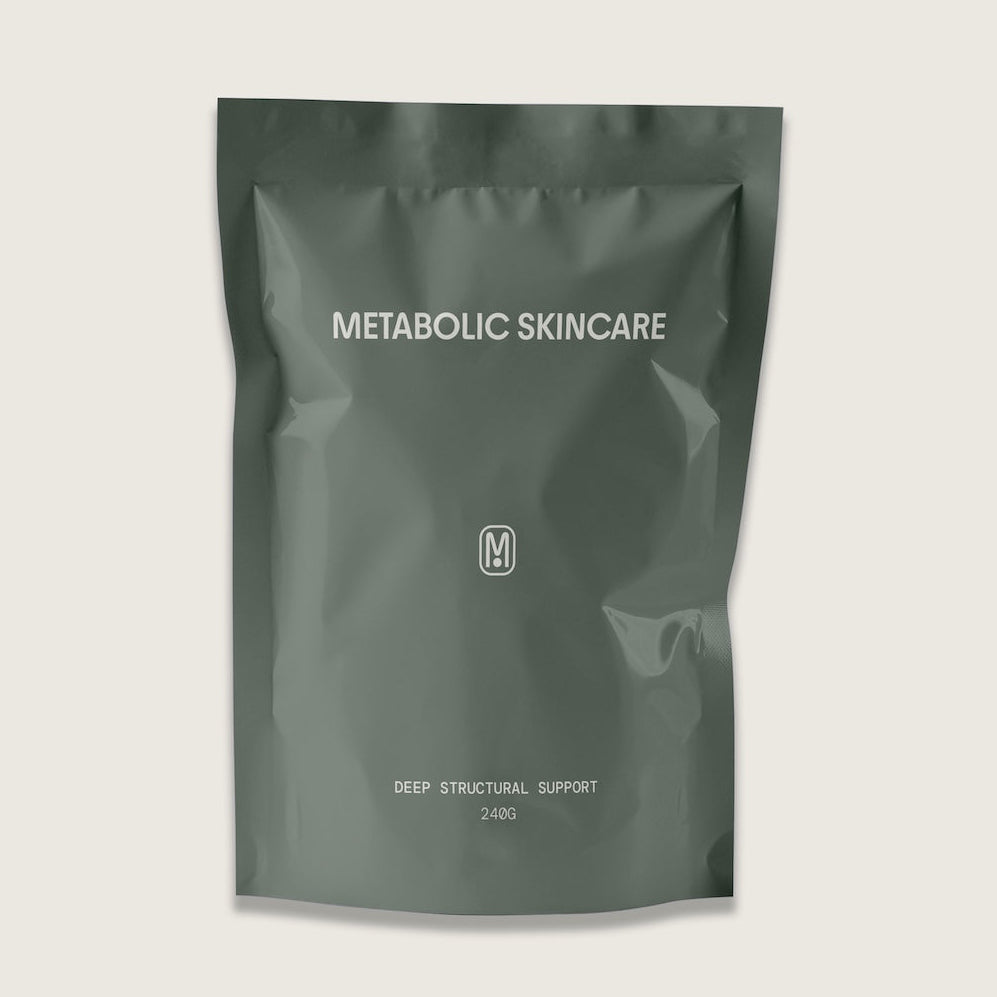
We built Metabolic Skincare's Deep Structural Support to satisfy all six, because when we went looking for a skincare supplement that did, we couldn't find one.

Hydrolyzed collagen peptides, in the absorbable form. Vitamin C, the cofactor that makes them usable. Hyaluronic acid for hydration where creams can't reach. A powder you stir into water each morning, dosed at the levels the research actually used. Made in an FDA-registered, GMP-compliant facility in California. And built on a formula whose ingredients and doses trace to peer-reviewed randomized controlled trials, which we'll show you, because we'd rather you read them than take our word for it.

It is not another thing to put on your face. It's the thing that goes in.

Skin is a readout of what's happening underneath. Support the system, and the surface follows.

Deep Structural Support. $49 for a month, or $39 a month on subscription, with the price locked for as long as you stay subscribed. If it doesn't do what we say, our 12-week guarantee sends your money back.

Try Metabolic Skincare

12-week money-back guarantee Cancel anytime $49 one-time or $39/mo

Read the clinical research behind the formula.

Isn't this just collagen powder?

No. Collagen is just one ingredient, and on its own it doesn't do much.

So we pair it with the other nutrients your skin needs to actually use it: vitamin C to put the collagen to work, and hyaluronic acid for hydration a cream can't reach, all dosed at clinical levels. Collagen is the start, not the whole answer.

Wow, I'm on my third order and seeing incredible results... ...love this product!
- TheresaSee product page for full review
Try Metabolic Skincare

12-week money-back guarantee Cancel anytime $49 one-time or $39/mo

Reference

  1. Reilly DM, et al. Dermatology Research and Practice. 2024. doi:10.1155/2024/8752787. PMID 39021368. (12-week randomized, placebo-controlled trial of hydrolyzed collagen with vitamin C. 19.6% reduction in wrinkle depth and 22.7% increase in skin elasticity versus placebo.)

    ↩

These statements have not been evaluated by the Food and Drug Administration. This product is not intended to diagnose, treat, cure, or prevent any disease. Individual results may vary.

Deep Structural Support
Try Metabolic Skincare